How the Internet-of-Crops® Models Grain Conditions
This article explains how the Internet-of-Crops® platform combines real sensor data and advanced modeling to create a complete, real-time picture of grain temperature and moisture conditions across each storage facility.
1. How Measurements Work
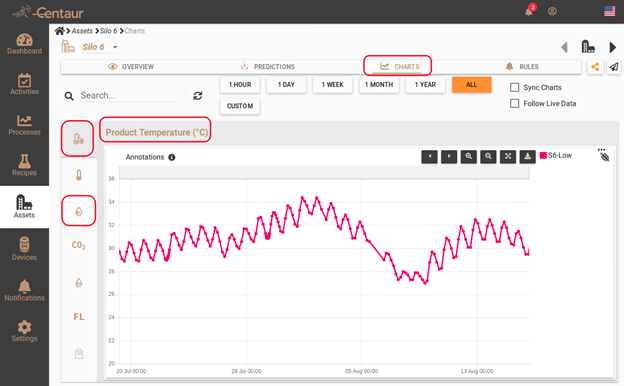
Centaur sensors measure temperature and moisture at a limited number of physical points inside the grain mass.
Although these values appear in charts like those in traditional monitoring systems, the real advantage lies in Centaur’s proprietary modeling methodology, which transforms a few measurements into a detailed, facility-wide profile.
Users can view sensor readings and their variations over time in the “Charts” tab of the platform:
2. Centaur Innovation – Grain Modeling and the Digital Twin
The Internet-of-Crops® platform generates a digital twin of each facility and simulates the internal conditions of the stored product.
Using physics-based modeling, the platform estimates key variables across the entire grain mass, not just where sensors are placed.
The simulation integrates inputs such as:
-
Type and quantity of product
-
Geometry and dimensions of the storage structure (e.g. metal silo or concrete flat warehouse)
-
Local weather and ambient conditions – using software or hardware weather stations

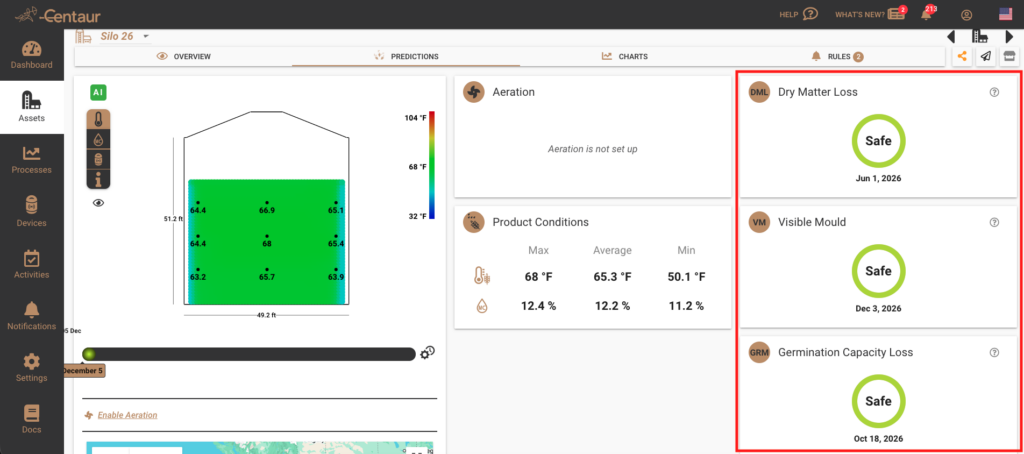
From these, the model also derives critical grain quality metrics, including:
-
Dry matter loss (DML)
-
Visible Mold development risk (VM)
-
Germination capacity (GRM)
3. The Science Behind the Model
Centaur’s modeling engine is grounded in thermodynamics and heat transfer principles. On the cloud, each of your storage assets is simulated using a physics-based methodology, known as CFD (Computational Fluid Dynamics). This is an established, rigorous scientific approach also employed for engineering systems as diverse as rockets, HVACs, or even capillary artery surgical procedures.
Rather than functioning as a simple data logger, the sensors serve as reference points that continuously validate the model’s calculations at specific locations within the asset. The platform compares measured values to modeled estimations and updates the simulation in real time, effectively “learning” the facility’s behavior.
This process results in a continuously updated map of temperature and moisture across the entire stored product, representing thousands of virtual data points from just a few real sensors.
4. Using Rules and Alerts
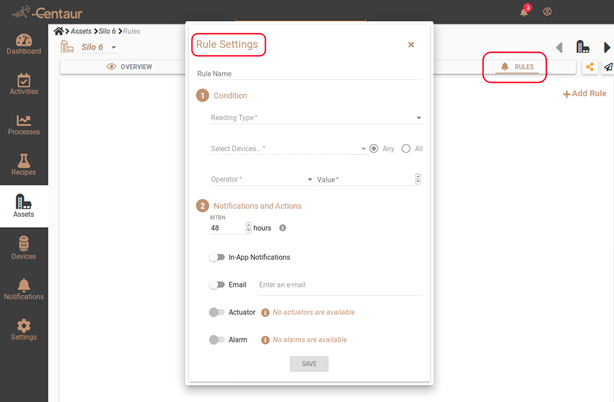
Users can define rules and thresholds to automate responses or receive alerts when conditions deviate from safe parameters.
These rules operate on the digital twin, meaning alerts and actions reflect the entire grain mass—not just a single sensor location.
For example:
If moisture exceeds 16% on one side of a silo, the system can automatically trigger:
-
An alert to the operator,
-
A control signal to activate fans or cooling units.
When abnormal temperature or moisture levels are detected, users may also:
-
Take physical grain samples for verification, or
-
Follow the recommended remediation actions in the Help Center.
Summary
Centaur’s Internet-of-Crops® platform transforms limited sensor data into a high-resolution, dynamic model of stored grain conditions.
By integrating physical measurement, physics-based modeling, and automation, it empowers users to make data-driven decisions that maintain product quality, reduce losses, and ensure safe storage conditions.